
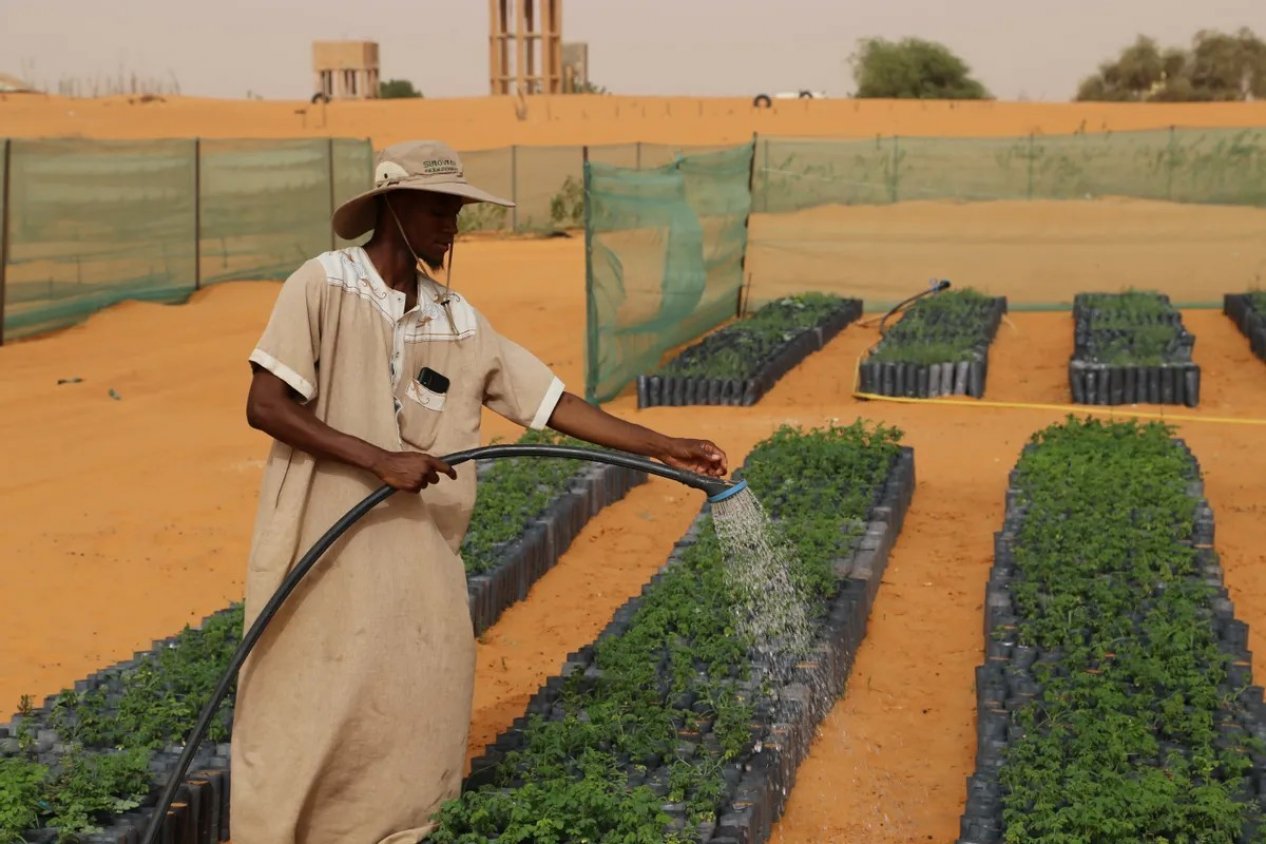
Such a plan has been in the works since 2007 and involves the participation of numerous African countries. Its aim was to have trees extend like a belt across the Sahel region, which is at the base of the Sahara, in order to prevent the expansion of the desert due to climate change.
According to social media posts on Facebook and other platforms, more than 20 African countries are a part of this effort to plant trees across the continent from coast to coast:
Across Africa, more than 20 countries are building something extraordinary together: the Great Green Wall. This massive belt of trees stretches from coast to coast along the southern edge of the Sahara, designed to stop the desert's spread and restore land that's been degraded for generations.
But here's what makes this different from other environmental projects. It's not just about planting trees—it's about restoring livelihoods for millions of farmers and communities who depend on this land. It's about fighting climate change by creating ecosystems that actually support people, not just preserve them behind barriers.
Imagine a living wall visible from space, built not to divide but to heal and unite an entire continent. That's the cultural shift we're witnessing: when nations choose collaboration over isolation, when environmental action becomes community action.

(Facebook user Culture Collective)
The posts are mostly true, in that this is a real effort being carried out by African countries, though the stated length of the wall upon completion varies. According to recent news coverage, the initiative is perceived as an overall failure with only small success stories.
According to the United Nations Convention to Combat Desertification, the project aimed "to restore Africa's degraded landscapes and transform millions of lives in one of the world's poorest regions, the Sahel. Once complete, the Wall will be the largest living structure on the planet – an 8,000 km natural wonder of the world stretching across the entire width of the continent."
The goal was to have the "wall" extend from Senegal in the west to Djibouti in the east, by 2030. The now-defunct official website of the Great Green Wall inititative detailed the reasons behind all their efforts:
The catalyst for the Great Green Wall is the daily impact of desertification and climate change that is undermining the futures of millions of communities across Africa's Sahel region.
Since the 1970s, the Sahel has been heavily affected by recurrent periods of drought. These droughts have threatened the livelihoods and future of entire populations across the region.
The lack of rain has led to the disappearance of livestock and the destruction of cereal crops. The great famines that rocked the Sub-Saharan region in the 80s each affected millions of people. In addition, the high population growth rate is increasing demand for food and pressure to gain access to other natural resources which are the basis for livelihoods and the survival of the rural population.
Millions of people – particularly rural youth – are currently facing an uncertain future due to the lack of decent rural jobs and continuous loss of livelihoods due to land degradation and falling yields.
But according to a 2021 Associated Press report, since the project's inception in 2007, millions of the planted trees have died due to diminishing rains and rising temperatures. Only 4% of the project's original goal has been met and around $43 billion is needed to complete it. Given these challenges, the focus of the project has shifted from planting just a wall of trees to a "mosaic" of smaller and more durable projects that emphasize community-focused solutions that support agriculture and prevent desertification.
The Great Green Wall's old website claimed a number of successes. Senegal planted around 12 million drought-resistant trees in less than a decade, while 5 million hectares of degraded land was restored in Nigeria, and 15 million hectares in Ethiopia. A November 2021 report in the journal Nature Sustainability assessed the economic effect of the program and concluded that it was economically worthwhile:
The Great Green Wall programme is a colossal initiative to restore 100 million hectares of degraded ecosystems across 11 countries in the region […] We evaluated the economic costs and benefits of future land restoration projects under this programme. We applied different scenarios that account for both market-priced and non-market benefits from restored ecosystems and consider the heterogeneity of local decision-making contexts in terms of investment planning horizons, discount rates, and the time needed for the restored ecosystems to start yielding their benefits in full. The results show that every US dollar invested into land restoration yields on average US$1.2 under the base scenario, ranging from US$1.1 to US$4.4 across the scenarios. At most, ten years are needed for land restoration activities to break even from the social perspective, accounting for both market-priced and non-market ecosystem benefits. To fund all proposed land restoration activities, an investment of US$44 billion is needed under the base scenario (US$18–70 billion across scenarios).
The report added that "violent conflicts in the Sahel are estimated to reduce the accessibility to these degraded ecosystems from 27.9 million hectares to 14.1 million hectares."
While originally only 11 countries were a part of the effort, more than 20 African nations have participated. This video from September 2020 detailed some of the projects and their effect:
In 2007, more than 20 African countries partnered up in a project to tackle desertification through the spread of the Sahara Desert, which was conceived as a giant wall of trees meant to stretch from coast to coast of the continent. Over time, the focus shifted to smaller-scale planting programs that go beyond just trees. The official goal for the length of the "wall" was 8,000 km. Today, however, reports show that the project has done poorly.