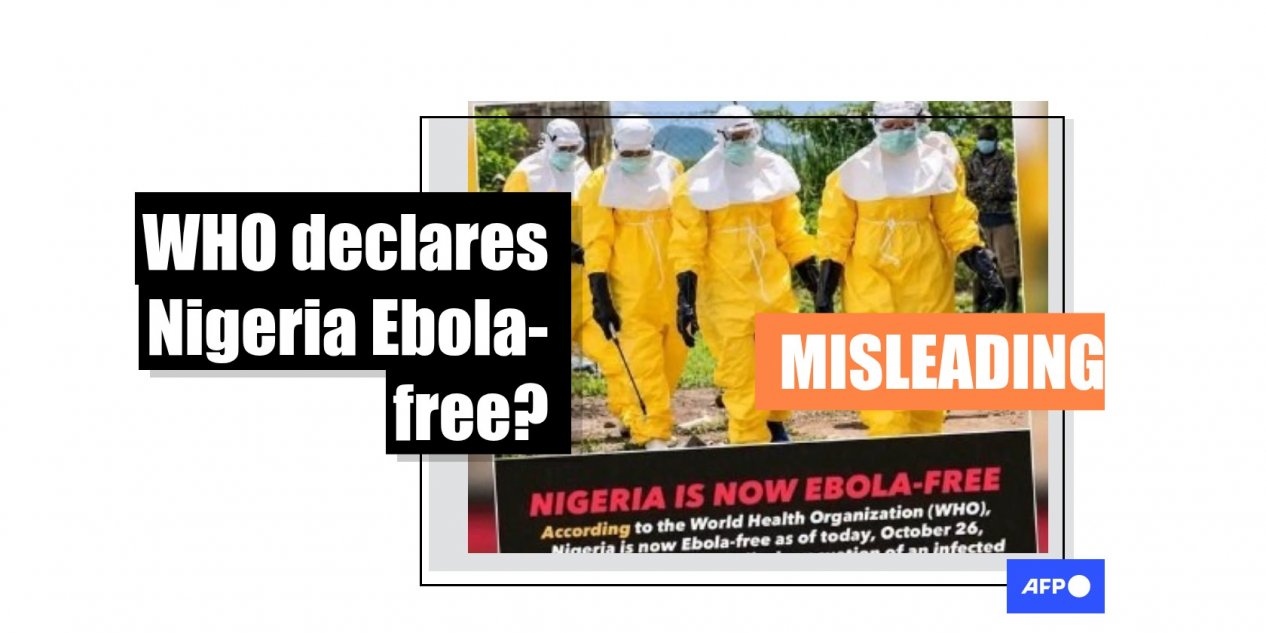
After the World Health Organization's (WHO) regional director for Africa said Nigeria had "no Ebola cases" following the medical evacuation of the country's only confirmed Ebola patient to Switzerland on October 26, posts and headlines inaccurately suggested the country was "Ebola-free". However, these remarks have been misrepresented online. Under its own criteria, the WHO will only declare an Ebola outbreak to be over after 42 consecutive days without a new confirmed or probable case.
The latest Ebola outbreak in Africa has killed more than 5,300 people, mainly in the Democratic Republic of Congo (DRC), according to data shared with AFP by the Africa Centres for Disease Control and Prevention (archived here).
To date, 10,444 cases have been confirmed since mid-May, with a fatality rate of more than 50 percent.
Ebola is a severe and often fatal viral disease transmitted through direct contact with the bodily fluids of an infected person. Common symptoms include fever, fatigue, muscle pain, vomiting and diarrhoea, while severe cases may involve internal or external bleeding (archived here).
The disease has claimed more than 15,000 lives in Africa over the past 50 years.
The current outbreak, caused by the Bundibugyo strain, one of three viruses known to cause large outbreaks, began in the DRC in May. The country is experiencing its 17th Ebola outbreak, which has since spread to Kenya, Nigeria and Uganda (archived here).
No vaccine is currently approved for Bundibugyo, but clinical trials began in recent weeks with the Ervebo vaccine, which has been effective against the more common Zaire strain (archived here).
Nigeria case
Nigeria’s health minister Muhammad Ali Pate confirmed the country’s first case on October 20 involving a 42-year-old Swiss woman who contracted the virus following a trip to Uganda (archived here).
The WHO said the patient, the wife of a Swiss embassy employee in the capital, Abuja, developed symptoms on October 7, four days after arriving in Nigeria. She sought care at a private facility in Abuja on October 11 and tested positive for Bundibugyo on October 20 (archived here).
On October 26, Mohamed Janabi, regional director for WHO in Africa, announced that: “The Ebola patient in Nigeria and her contact, who is also her husband, were medically evacuated to Switzerland” (archived here).
“With the evacuation of the patient and her husband, Nigeria currently has no Ebola cases,” Janabi added.
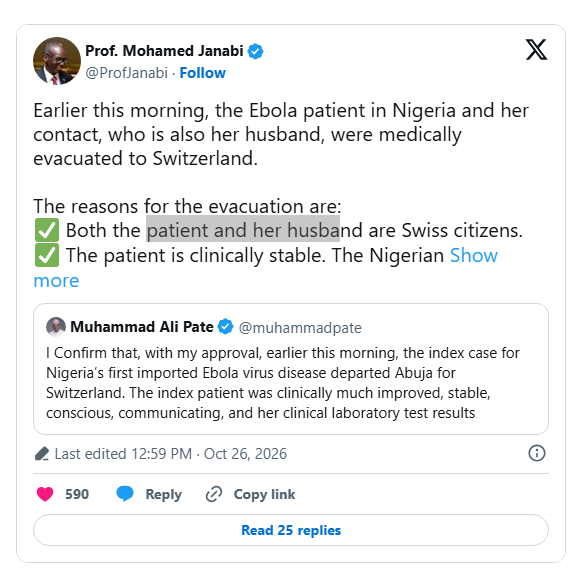
Although Janabi did not explicitly state Nigeria was "Ebola-free", the announcement was followed by several misleading posts that made this claim.

A Facebook post shared on October 27 contains a graphic reading: “NIGERIA IS NOW EBOLA-FREE.”
“According to the World Health Organization (WHO), Nigeria is now Ebola-free as of today, October 26, 2026, following the medical evacuation of an infected patient and her husband to Switzerland for treatment,” it adds.
The graphic includes an Associated Press (AP) photo from May 20, showing Red Cross workers in personal protective equipment at a health centre in the DRC (archived here).

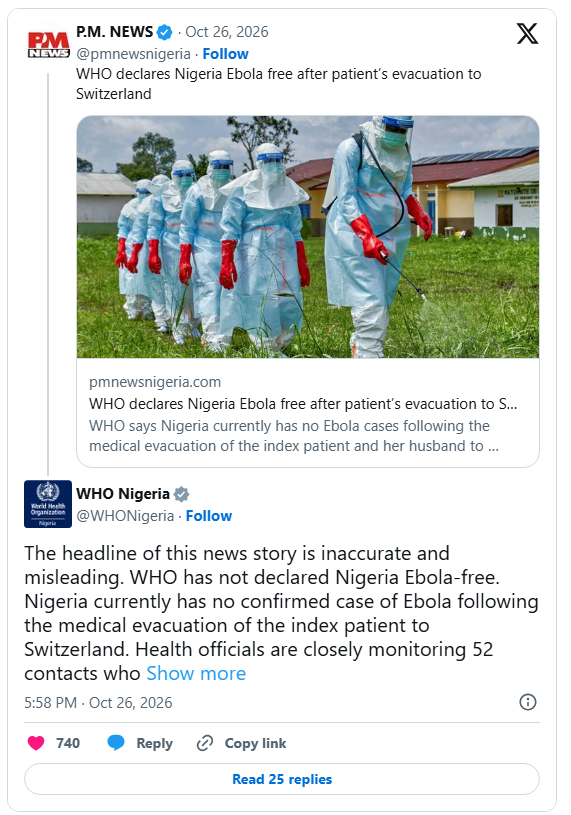
Similar headlines, including one from local news outlet PM News, circulated on X.

‘42-day countdown’
On October 26, the WHO Nigeria replied to the PM News post, saying the headline was “inaccurate and misleading” and clarifying that “WHO has not declared Nigeria Ebola‑free” (archived here).
It reiterated that “Nigeria currently has no confirmed case of Ebola following the medical evacuation of the index patient to Switzerland” and that health officials are “closely monitoring 52 contacts who may have been exposed”.
The WHO explained: “A country can only be declared Ebola‑free after a 42‑day countdown following the last confirmed case testing negative twice for the virus or, in this situation, after the evacuation of the confirmed case”.
According to the health body’s continental response plan for Bundibugyo virus, the principal benchmark for downgrading risk is 42 consecutive days with “no confirmed or probable Ebola cases, equivalent to twice the maximum incubation period of 21 days” (archived here).

This period accounts for the risk of re-emergence, allowing authorities to monitor for new infections, including among people who may have been missed during contact tracing, the virus persisting in a patient or in equipment, and the disease being endemic in the region (archived here).
The WHO’s recommended criteria for declaring the end of an Ebola virus outbreak calls for coordinated public messaging that guards against misunderstandings and stigmatising survivors. It also urges warning of possible flare-ups and avoiding absolute terms like “Ebola-free” (archived here).
Uganda, for example, ended its Ebola outbreak on August 27 after completing the 42-day countdown according to the WHO (archived here).
Two more suspected cases in Nigeria tested negative for the virus on November 1. If no further cases emerge, the country could declare the end of its outbreak by December 7 (archived here and here).