

By Joey Esposito snopes/fact-check/
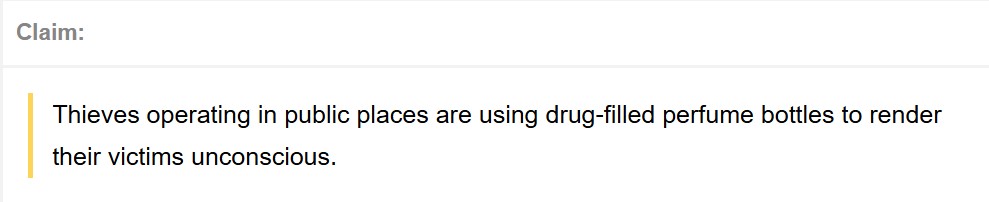
An urban legend that has long plagued the internet returned in May 2026, with social media users claiming that strangers are approaching women in public places such as parking lots and movie theater bathrooms and robbing them after knocking them out using drug-laced perfume.
People spreading the familiar rumor claimed women were being drugged with a substance called "Axter."
Snopes first debunked this in June 2000, followed by the debunking of a related claim in June 2001 about women supposedly dying from smelling drugged perfume samples sent through the mail, which the U.S. Centers for Disease Control and Prevention also disproved at the time.
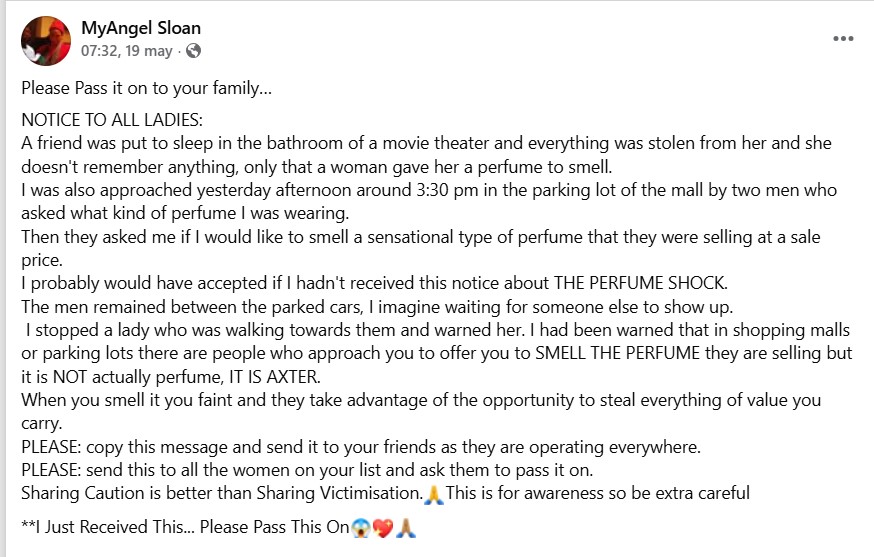
The rumor was false, but the popularity of the debunked claim, particularly on Facebook, prompted Snopes readers to reach out via email for us to investigate the veracity of the rumor. In fact, Snopes has received nearly 1,300 emails about this rumor since 2015.
Indeed, this claim spreading in 2026 mirrored the one Snopes debunked in 2000, except the drug of choice has changed from "ether" to "Axter." Even small details like the alleged perpetrators "waiting between parked cars" for another victim are similar to the original rumor that began circulating as far back as 1999, according to Snopes' previous reporting.
Snopes' research suggests "Axter" might be intended to refer to a brand name for hydroxyzine, an antihistamine the Mayo Clinic describes as a doctor-prescribed drug "used to help control anxiety and tension caused by nervous and emotional conditions. It can also be used to help control anxiety and produce sleep before surgery."
However, in our research we found only one pharmacy, Frank Ross Pharmacy in India, carries a drug called Axter, which the pharmacy lists as containing hydroxyzine. Atarax is a more widely recognized brand name for the drug.
We've reached out to the Food and Drug Administration for clarification on whether Axter is a legitimate brand of hydroxyzine, as well as for information about the possibility that a person could even be subdued using hydroxyzine through the methodology described in the claim. We will update this article if we receive a response.
The National Library of Medicine says hydroxyzine as may cause drowsiness or dizziness.
Whether drugging-via-hydroxyzine is technically possible or not, this claim is still false, simply an evolution of the same urban legend that's been circulating nearly as long as the internet has been mainstream. This claim is what's known as a copypasta, an internet phenomenon Snopes previously described as:
A portmanteau of "copy" and "paste" (and a wink), copypasta is copied-and-pasted text shared online. Often its content pleads with readers to pass along some warning or advice to help others, or an offer of free cash or merchandise from some big company, when in fact it's just a bit of fiction meant to trick or embarrass the person who shares it. Some examples of shockingly effective copypasta fact-checked by Snopes years ago still pop up in our inbox almost every day.
Most instances of this particular copypasta insist these are secondhand stories heard from a friend or someone they know. No reputable news outlets have reported on this claim. Further, we could not find any legitimate evidence or reports that these sorts of attacks have taken place, and certainly not at the frequency with which the claim would have you believe.
An undated memo from the University of California, San Diego, Police Department hosted on the agency's website addresses this same claim. Though the page is undated, Snopes found archived versions of this page hosted on the Internet Archive dating back to Jan. 26, 2003.
The memo reads:
A number of people on campus have reported receiving an email regarding males asking females to sniff a bottle of perfume. The email claims that the perfume is really ether and anyone who sniffs it will pass out.
This is an urban legend which began in late 1999 from an incident reported to the Mobile Police Department. Emails regarding this incident and several variations have been widely circulated. The details in the emails has changed over time. The emails showing up today contain the basics of the original but instead of cologne the knock out product is now perfume. Instead of an unknown, undetectable substance, the agent is identified as being ether. Most interesting of all, the moral of the story is no longer simply "beware of parking lot scammers." It has become "if not for these email warnings, I might have been a victim too."