Real video footage of humpback and blue whale calves nursing looks far less dramatic.

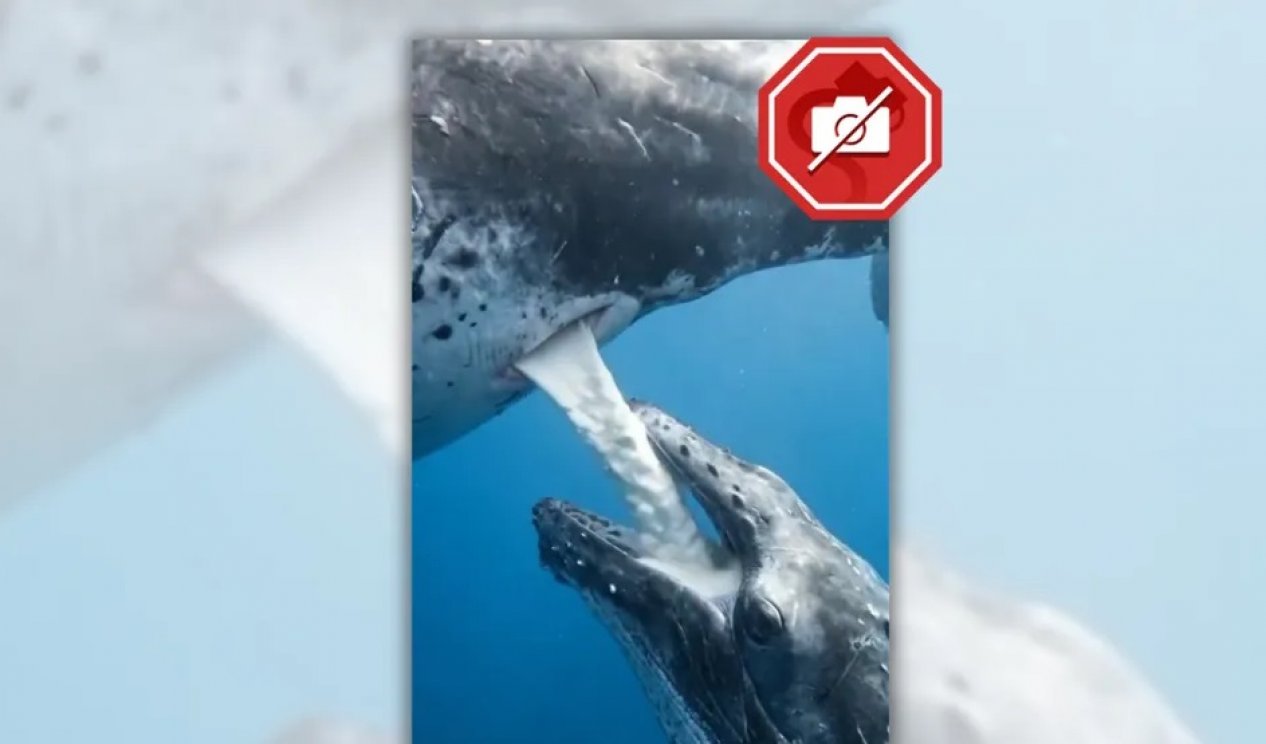
In mid-April 2026, people on social media shared a video of what they claimed was footage of a whale calf nursing from its mother. In the video, the calf swam a short distance from its mother, which released a large amount of a thick, white fluid toward the calf. The calf opened its mouth to drink the milk, much of which the calf missed or failed to drink. A narrator spoke in Spanish throughout the video.
For example, an X post (archived) of the video claimed the blue whale "produces milk so rich and thick it resembles flowing cream." The person who posted the video later corrected its caption by instead claiming the video was of humpback whales.
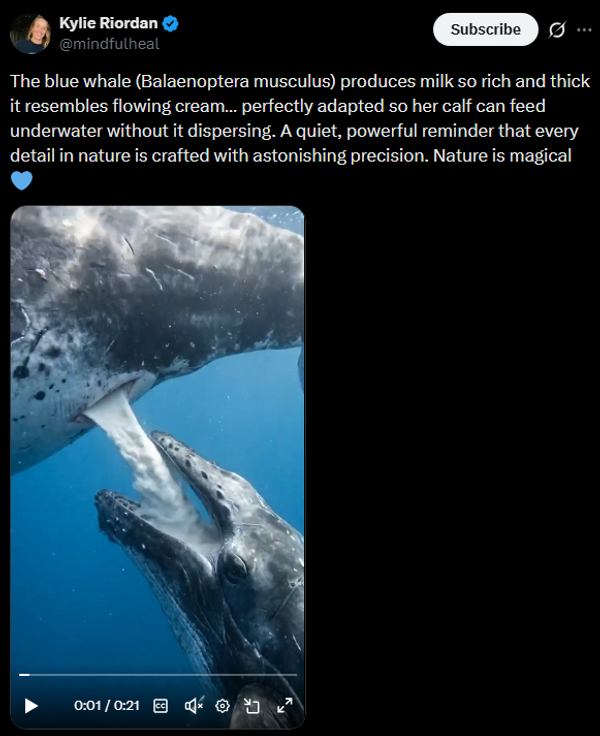
The video was also shared as either a pair of blue whales or humpback whales on YouTube (archived), Facebook (archived) and Reddit (archived).
This was not an authentic video of a whale calf of either species nursing from its mother. Real videos of these whales show that calves nurse in a very different way. Additionally, the video circulating on social media contained SynthID watermarks, which are invisible watermarks Google puts into all images and video generated or edited by its AI apps, indicating it was generated by artificial intelligence. Therefore, we've rated the video fake.
The whales in this video don't resemble blue whales and instead appear to be humpback whales. Nonetheless, this fact check will include information about both species of whales to fully address the claim.
Footage of blue whale calves nursing is scarce, but it does exist.
In 2015, wildlife filmmaker Patrick Dykstra captured drone footage of what appeared to be a nursing blue whale calf. In 2022 a diving expedition group in the waters of Timor-Leste recorded underwater footage of another nursing blue whale calf. While neither video offers an entirely clear view of the calf nursing, the calf is pressed up against the underside of its mother in both. Additionally, there is no "rich and thick" milk visible in the water like that seen in the AI-generated video.
Blue whale calves are rarely seen at all, according to the University of Washington School of Aquatic and Fishery Services, and those two videos appeared to be the only real footage of nursing behavior in the species. There are, however, at least four real videos of reasonable quality highlighting nursing humpback whales.
While on a diving expedition with a group in French Polynesia, filmmaker David Zamut, who posted several other videos from the same diving expedition, recorded one such video. In Zamut's video, the humpback calf can be seen putting its mouth directly up to the mammary gland of its mother. There is no visible milk in the water, except for possibly in the misty spray seen at the calf's mouth when it pulls away.
Cassie Jensen, a photographer who regularly posts videos she has recorded of whales and offers diving expeditions to see humpback whales in Tonga, recorded a similar video of a nursing humpback whale calf. The nursing calf can be seen putting its mouth up against its mother's mammary gland in that video, as well. There is no visible milk in that video except for some misty spray when the calf pulls away from its mother, just like what's seen in Zamut's video.
There are two other videos taken by researchers who suction-cupped cameras onto humpback whale calves to watch calves nurse from their own perspectives. The calves in these videos push up against their mothers, and the only milk visible in the videos is misty.
As for additional evidence that the video from the popular social media posts was AI-generated, the clearest hint is in the second clip. In that clip, the movement of the milk makes it appear as if it's flowing backward out of the calf's mouth and into the mother's mammary gland.
For further reading, Snopes has fact-checked a number of AI-generated videos and images about animals, including one as part of a claim that a flock of flamingos landed in a South Carolina woman's front yard after she put some plastic flamingos on display.